


Hello readers,
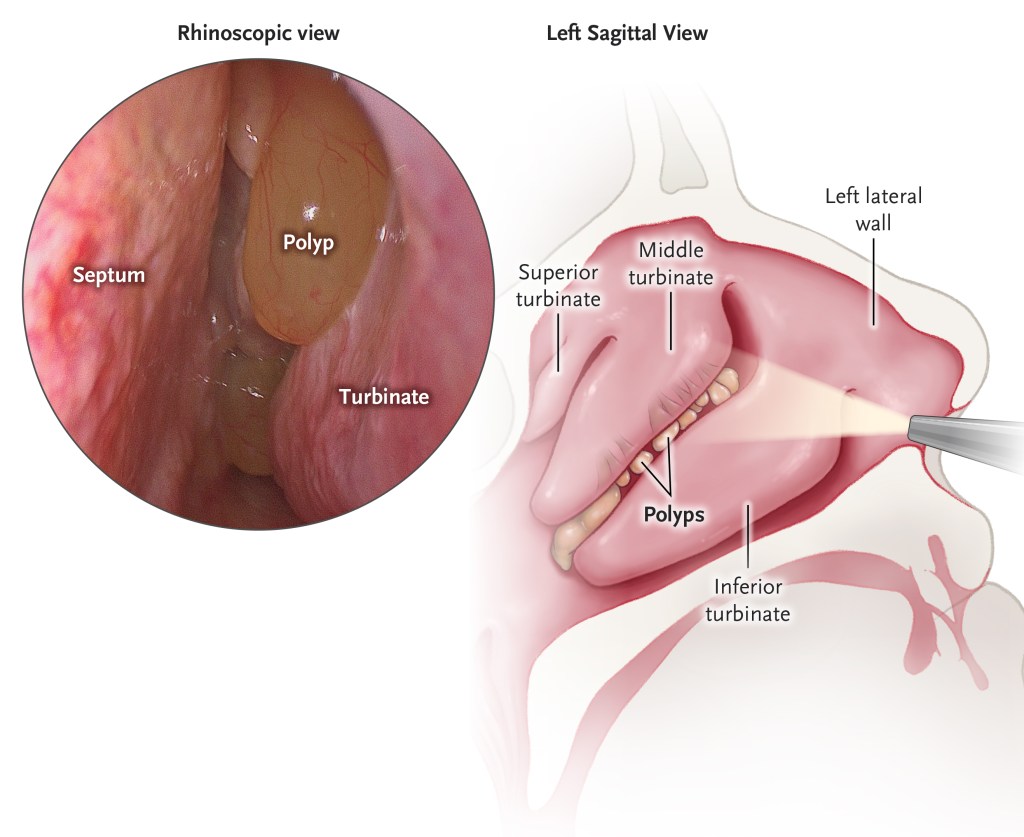
I will share a good paper from Rhinology Journal today – a research done in Singapore.
Histopathological report of polypoidal tissues from patients post functional endoscpic sinus surgery (FESS) is commonly done to see if there is any peculiar findings other than the normal inflammatory polyps such as inverted papilloma/other malignancies.
This paper aims to give prognosis of surgical outcomes of the CRSwNP (nasal polyp) patients post FESS – they grouped them into 3.
Kindly read the abstract below, and buy the article here for the complete report.

Latent class analysis of structured histopathology in prognosticating surgical outcomes of chronic rhinosinusitis with nasal polyps in Singapore
Rhinology 61-4: 358-367, 2023, Volume: 61 – Issue: 4
X. Xu – J.E. Seet – Q.V. Yap – S.S. Chao – M.K.T. Thong – D.Y. Wang – Y.K. Ong
BACKGROUND: Structured histopathology profiling is recommended when reporting chronic rhinosinusitis with nasal polyp (CRSwNP) tissue. The objective of this study is to identify features in structured histopathology that predict outcome after functional endoscopic sinus surgery (FESS) in a cohort of CRSwNP patients from Singapore.
METHODS: Latent class analysis was performed on structured histopathology reports of 126 CRSwNP patients who had undergone FESS. Outcome measures were polyp recurrence, need for systemic corticosteroids, revision surgery or biologics, and disease control at 2 years post-FESS.
RESULTS: Three classes were identified. Class 1 was characterised by mild, predominantly lymphoplasmacytic inflammation. Class 2 comprised of 100 eosinophils/HPF, hyperplastic seromucinous glands, mucosal ulceration and mucin containing eosinophil aggregates and Charcot-Leyden crystals. Classes 2 and 3 were significantly associated with uncontrolled disease at 2 years post-FESS. Class 3 was additionally associated with the need for systemic corticosteroids.
CONCLUSIONS: Eosinophil count, degree of inflammation, predominant inflammatory type, hyperplastic seromucinous glands, mucosal ulceration and mucin containing eosinophil aggregates and Charcot-Leyden crystals predicted need for systemic corticosteroids and uncontrolled disease at 2 years post-FESS. The presence of >100 eosinophils/HPF should be reported, as this subset of tissue eosinophilia was associated with less favourable outcomes after FESS.



 Dr. Ameen, ENT Specialist in Kuala Lumpur
Leave a comment